Every endpoint of the grid is under the responsibility of a balance responsible party (BRP). These are typically well known energy companies across the country. Every day, BRPs submit nominations for injections and offtakes from the grid for the next day. Any deviation from these nominations will be priced at the imbalance price. Imbalance price is therefore a financial penalty keeping the grid balanced. It can also become a revenue if deviations from nominations help decrease total system imbalance.
Imbalance price values have grown bigger in the last years, raising interest in the product. Indeed intermittent volatile renewable sources of energy have added imbalance on the grid directly translating into funkier series.
Quarterly imbalance price values through time
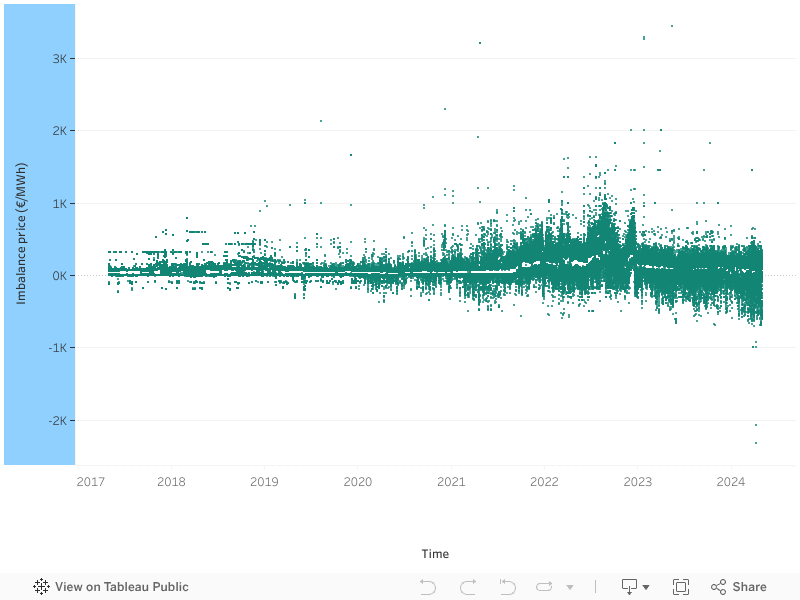
Imbalance price Belgium, Epon Energy Platform
There are several strategies to expose your solar power plant to the imbalance price. And in each of them, you will need to predict imbalance price values for the next quarter.
Illustration of imbalance prices predictions vs actuals
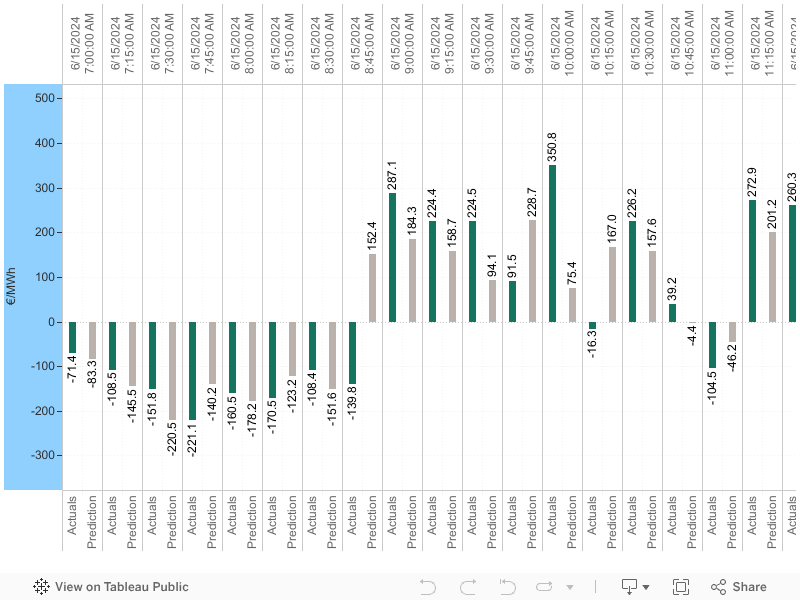
Imbalance price actuals vs imbalance price predictions for June 15th, 2024, Epon Energy Platform
There is a whole literature about imbalance price modelling. In this case, we used Long Short-Term Memory models. They perform well in this case as previous values of the system tend to hold explanatory power on the next values in the time series. Overall the model predicts the right direction (positive or negative) of the imbalance price 83.1% of the time. Mean absolute error is around 59.2.
The first way to expose your solar power plant to imbalance price is to mandate a BSP to deal with your solar output. It will include it into its global energy pool and direct it to the imbalance price as part of the a global portfolio strategy. You will then receive a profit sharing from the BSP that mostly depends on your contract.
While it results in extra profits for solar power plants, it does not exactly bring flexibility to the system as it mostly redirects produced energy from one market to another with no piloting of solar injections. It is however already observed on the market as it already brings extra profit for the solar power plant.
An second strategy is direct imbalance price exposure at the injection level. In this case the solar power plant will need to provide its own nominations and be responsible for both positive and negative deviations. This is currently rarely observed as there is still a lot of uncertainty in solar forecasting and nomination deviations. But technological development is quickly bringing us there.
There are several strategy to deal with local solar forecasting and nomination strategies, but for the sake of this demonstration, let’s assume a very basic one. We always nominate 0 injections for the next day and only turn on inverters when imbalance price prediction is positive.
0 nominations and positive imbalance injections
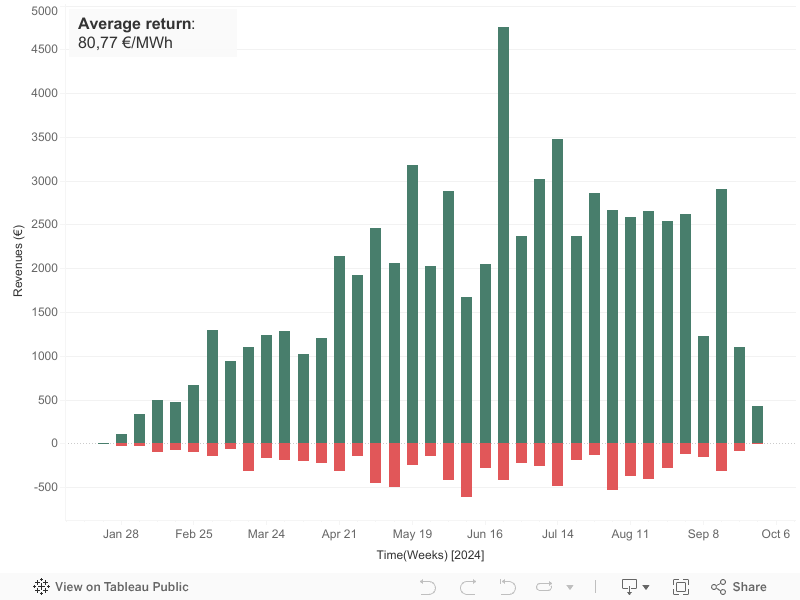
Revenues for 0 nomination and positive imbalance injections strategy for a 1 MWp solar power plant based in Brussels, Epon Energy
The average return of this strategy is 80,77 €/MWh.
Furthermore, while imbalance price predictions provide the good direction around 83% of the time, there are still some quarters where algorithms wrongly predict a positive imbalance price and injections are injected at a negative imbalance price. This explains the weekly losses (red).
Here is a focus on revenues and losses generated by the strategy for June 2024 specifically.
0 nominations and positive imbalance injections revenues and losses
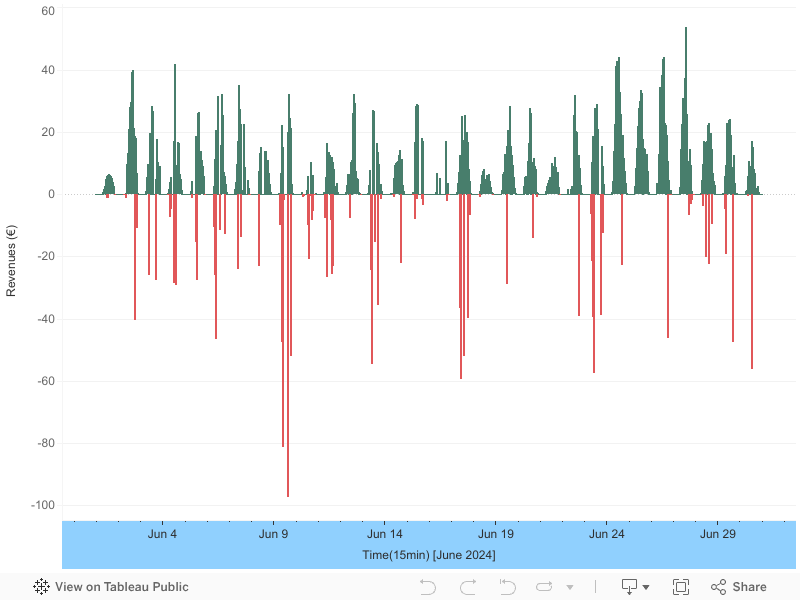
Of course, the next step is to nominate non zero values we are confortable to deliver and benefit both from positive and negative imbalance price values.
Direct imbalance price exposition is interesting as it effectively brings flexibility to the system and brings new revenues for solar power plants.
“Are solar power plant still making money ?” details current financial situation of solar power plants as well as current market evolutions