Economics of solar power plants can get sophisticated to say the least. Introduction (and removal) of public incentives, fluctuation of energy supply and consecutive increases of negative daily prices may have left some actors wondering.
There are several ways to profit from solar power plants.
1. Auco-consumption (Behind the meter)
The most profitable way of enjoying a solar energy is to consume it locally, straight after generation. This is the case of residential owners with panels on their roof or even industrial players producing their own power.
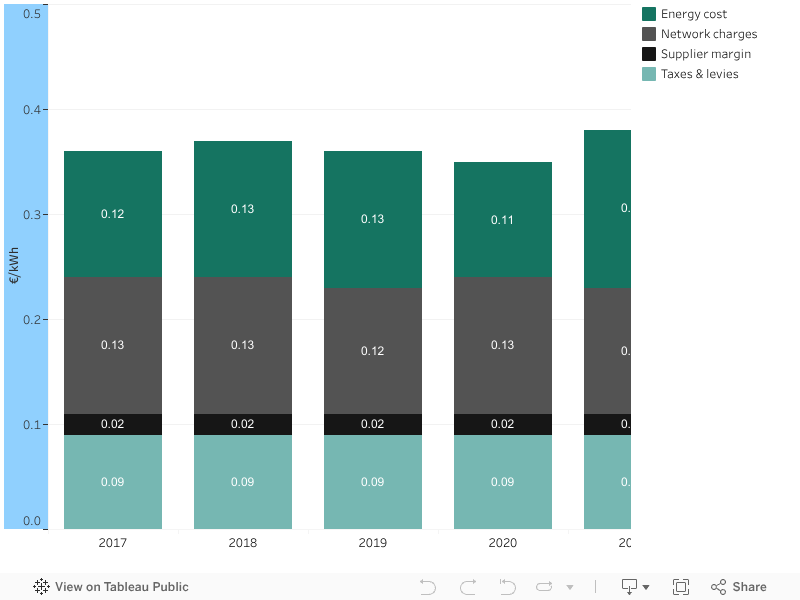
The rational here is simple. Around two thirds of the electricity price is justified by network charges, suppliers margins and taxes. Skipping them proves very beneficial.
Electricity price components in Belgium through time
Eurostat, Statista, FPS economy
In 2023 for example, auto-consumption would spare a household 250€/MWh. (0,12+0,02+0,11 €/kWh). Of course, each electricity consumer has its own contract conditions and the local cost of energy production varies. Industrial consumers usually manage to reduce their electricity price, but we get the idea.
2. Spot injections
Injecting electrons in the grid gets paid at the day-ahead spot price. It is an hourly price defined in advance by electricity markets. It is also called the day-ahead electricity price.
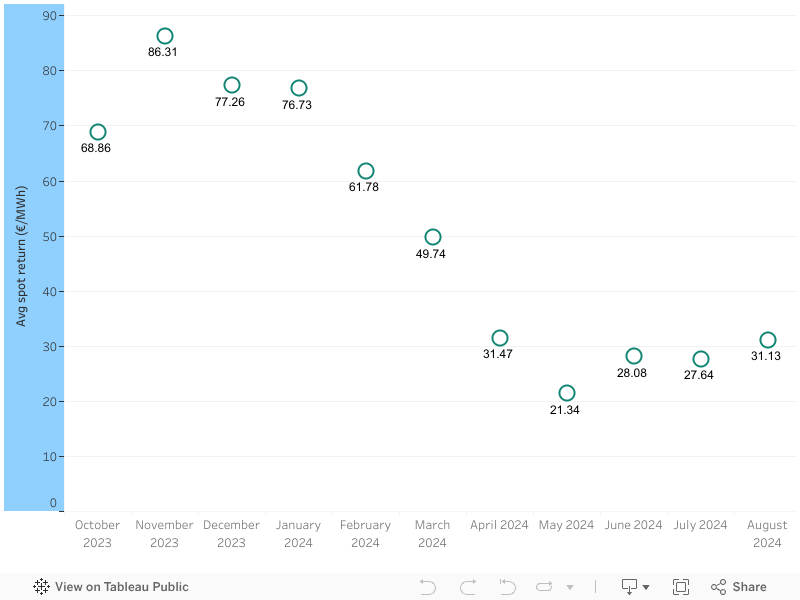
While it has definitely been a source of income for solar energy producers, it is getting flaky. The sharp increase of solar capacity at the national level results in simultaneous surge of solar production on sunny days. The grid gets overloaded and electricity prices tend to or go below 0.
Average spot returns on a solar installation from October 2023 to September 2024
Epon Energy
The owner of this solar power plant got paid an average 38 €/MWh injected in the grid.
Here is the catch. Spot returns remain interesting during colder months but rising unsupervised solar production in Belgium undermines spot returns during sunnier months.
“The rise of solar capacity” gets into the details of spot prices evolution and solar incompressibility.
3. Public subsidies
To support solar development at its inception, Belgian authorities implemented subsidies. The main policy was called green certificates (GC) and intended to pay extra money for each MWh produced. Coefficients varied across regions, but mainly generation of solar power would earn GC, that would after be sold to external private companies incentivised to acquire them.
The purchasing of GC is organised as a private market. The purchasing price has been changing from year on year and across Belgian regions. Overall, it varied between 65 and 150€/MWh. As a result of overproduction it currently sticks to 65€/MWh, which is the floor price Belgian authorities are themselves ensuring.
Green certificates definitely boosted solar power plant development. It also artificially steroided the industry. They all are expected to be over soon while our energy roadmap expects solar power to grow twice as fast as it did under these conditions.
4. Purchase power agreements (PPA)
PPA is another source of revenues for solar power developers. Mainly for pure injection profiles (meaning you inject 100% of the production). A solar developer enters a long term agreement with a buyer to sell generated electricity at a fixed predetermined rate. The buyer is usually an industrial or commercial entity aiming to ensure a renewable, foreseeable source of energy in the long term.
PPA is a very comfortable option for solar developers. However PPA are becoming harder and harder to get as appetite from buyers seems to fade. Indeed volatile and increasingly negative electricity prices make it more and more difficult to take all the risk on their side. It also tends to decrease the average price of the PPAs. In 2024 PPA rates for solar power would approach 65€/MWh.
Average PPA rates for solar power in Europe
| Q1 2022 | Q2 2022 | Q3 2022 | Q4 2022 | Q1 2023 | Q2 2023 | Q3 2023 | Q4 2023 | Q1 2024 | Q2 2024 | Q3 2024 |
| 50 € | 60 € | 69,5 € | 77 € | 74 € | 72 € | 74.5 € | 72 € | 67 € | 63 € | 64 € |
LevelTenEnergy
5. Actual returns
So we approximated main sources of revenues for solar power plants.
| Auto-consumpt. | Spot injection | Subsidies | PPA | |
| Average returns | 250 €/MWh | 38 €/MWh | 65 €/MWh | 65 €/MWh |
As a solar power plant owner, you are likely to find yourself in one of these or a mix of these situations.
| Residential | Industrial | IPP with injection | IPP with PPA | |
| Auto-consumpt. | 37% | 40% | 0% | 0% |
| Injections | 63% | 60% | 100% | 100% |
IPP stands for independent power producer
Empirically, industrials tend to auto-consume more as their consumption lies during working hours.
And your profitability would approximate something like this. We removed green certificates from the case as they are all soon to be over.
| Residential | Industrial | IPP with injection | IPP with PPA | |
| Total revenue | 116,4 €/MWh | 122,8 €/MWh | 38 €/MWh | 65 €/MWh |
| Savings | 92,5 €/MWh | 100 €/MWh | 0 €/MWh | 0 €/MWh |
| Spot | 23,9 €/MWh | 22,8 €/MWh | 38 €/MWh | 0 €/MWh |
| PPA | 0 €/MWh | 0 €/MWh | 0 €/MWh | 65 €/MWh |
6. And so what ?!
The costs of building a solar power plant depends on several factors. Mostly installation size, grid access, panels technology and place of installation. All in all a solar power plant will cost between 400 and 600€ per kWp. There are a lot of different setups but in order to make sense financially a solar power plant should reach a minimum revenue range of 70-80 €/MWh.
Residential and industrial installations are likely to remain profitable. The more the level of auto-consumption the more the solar power plant is profitable. This is already properly understood by the market that is increasingly asking for installations downsized to fit only auto-consumption needs. It is even further requested as people tend to fear volatile, negative injection prices.
On one hand, it is interesting as the market freely incentivises a decentralised production of energy. It is nonetheless also concerning as the overall auto-sufficiency of a downsized installation decreases. It is also not exactly the perfect market incentives for an acceleration of the overall solar Belgian capacity.
Independent power producers developing bigger scale installations with substantial solar energy injections are currently faced with the simple fact that the market might be a bit stretch. They might combine auto-consumption setups with substantial extra capacity or develop pure injection solar farms, they will more often than not find themselves in a situation where the solar power plant stands very few chances at the funding stage.
Again, big scale solar power plants have not been the main source of solar power in Belgium so far. And we might willingly keep it that way. It is however unanimously recognised we unequivocally need them in order to reach our solar capacity targets in the next years.