Proper solar forecasts are fundamental in managing energy systems with a growing share of solar power. Literature on the matter is evolving by the day and AI Powerhouses like Deepmind, along with academicians are both moving the lines on solar forecasting capabilities.
Let’s go through most exciting recent developments.
Cloud motion tracking
Generative artificial intelligence boom led scientists on the quest for local clouds motion prediction. Fisheye cameras are installed at the power plants locally. Historical clouds evolution is recorded and generative neural networks are trained to output the state of the sky during the next timeframe. Sky-imaging-based forecasting significantly improves short term forecasting. It is less interesting for longer timeframe predictions, as it is of course limited by its sight.
Sky-imaging-based forecasting illustration
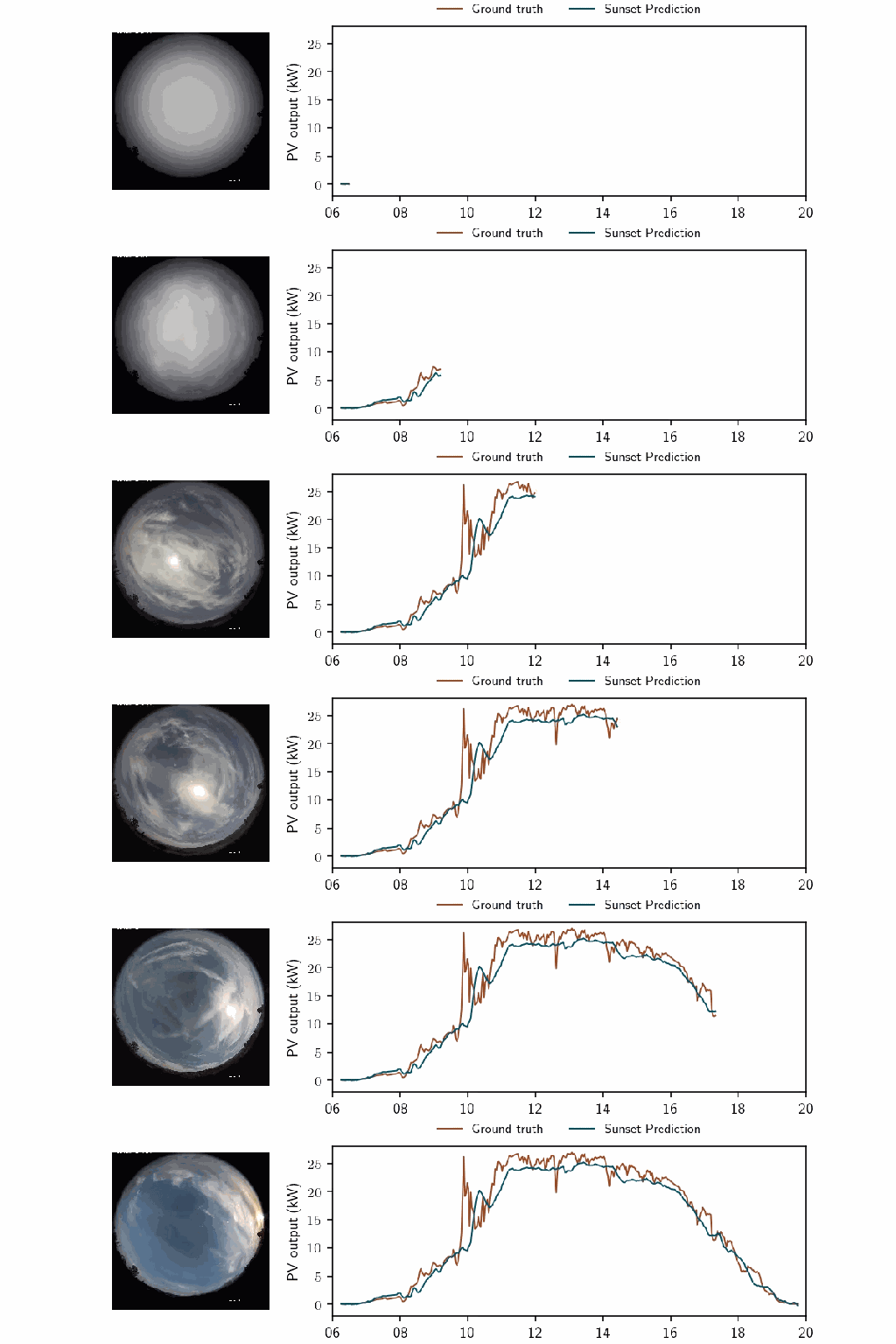
SkyGPT
Transfer learning on new site
Forecasting a solar power plant production requires a lot of historical data. Latest AI models have often failed to improve performance as new power plants often lack the sheer volume of data they require. Using generic models for a new power plant is also tricky as production is dependent on several local factors like ambient conditions, cloud cover or orientation.
Transfer learning addresses this exact situation by both transferring knowledge from a corpus of historical data from well monitored power plant across the country, and then fine tuning local models on local conditions. The main take away from this is to be able to quickly get a new solar power plant forecast up and running.
New age of satellite data
Space satellites market has exploded in the recent years. Further, open initiatives (NASA, ESA) have given open access to high-resolution and frequent imagery. For solar forecasting this offers exciting new opportunities. Especially frequent, high quality monitoring of cloud movements and types have improved short term forecasts (minutes to hours).
Estimated active satellite growth in recent years
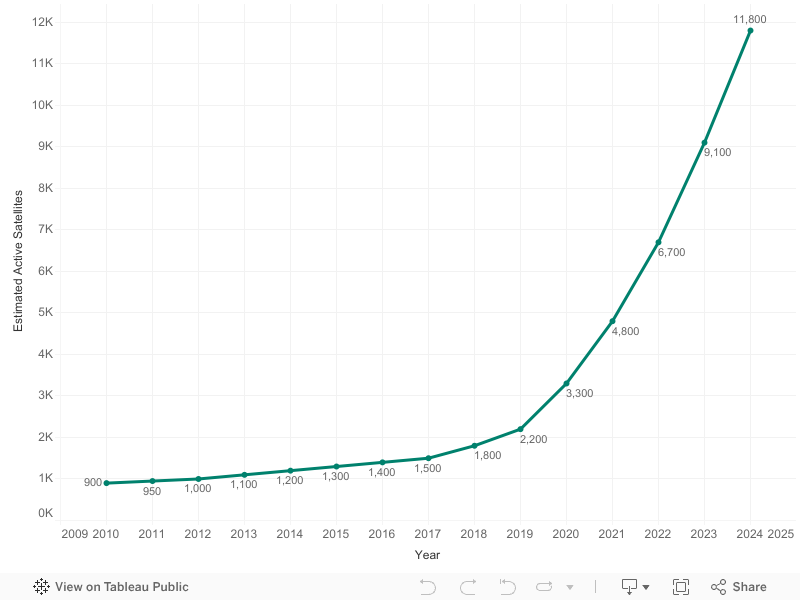
OECD, ESA
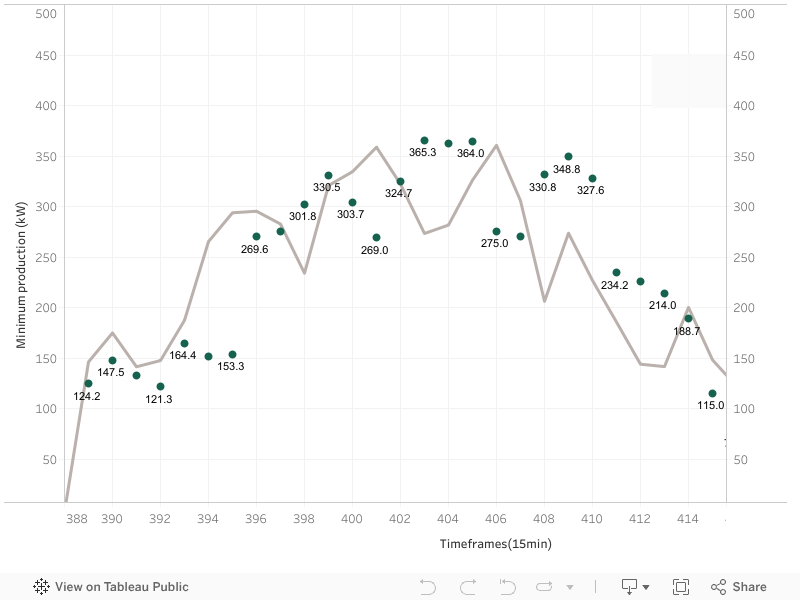
Let’s illustrate what this all means from a real life case. Here is a prediction of the quarters minimal production value, of a solar power plant on a cloudy day of 2024.
Minimal production value prediction vs actuals illustration
Epon Energy
Predictions are recorded 25 min before the quarter starts
Quarter solar forecasts (green dots) tend to come close to actual production (grey line). Indeed cloud motion tracking or intensive satellite image processing enable forecasting models to increase performance on shorter timeframes in volatile (cloudy) conditions. Overall, assessing performance over a year on these predictions will give you a MAE of 11.8%.
Once we are confident with our solar prediction for the next 40min, we open a few ways to answer the grid’s request for flexibility. One is to steady our solar output to offer it on ancillary services, as described in next post “Steady the solar profile with accurate forecasting”.
A second one is to get direct exposure to the imbalance price by ensuring accurate nomination on the day-ahead market. This is described in the post “Imbalance price market and solar energy“.