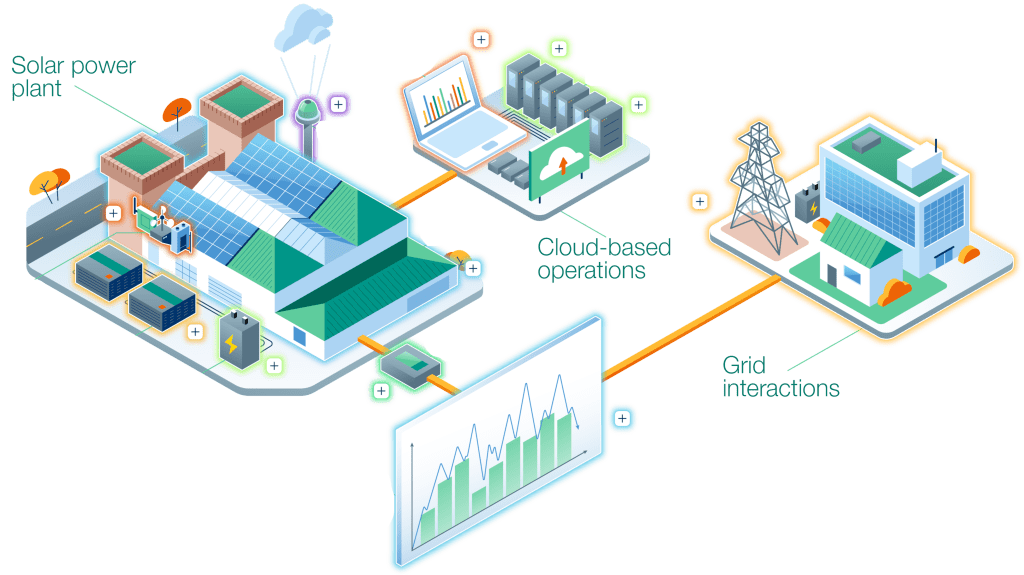
The Arsenal power plant is a solar power plant located on the roof of the iconic Arsenal building in Brussels. This power plant has been built by Epon and is dedicated to showcase real-life execution of flexible strategies for solar injections.
The setup is typical of Belgian solar power. It powers an industrial building, solar production is auto-consumed and leftover is injected in the grid. And as for every solar power plant in Belgium, injections are facing a growing number of negative prices and return gets lower and unpredictable.
Let’s take a closer look !

Solar power plant equipment
The solar power plant is equipped with a network of sensors dedicated to monitoring and predicting accurately solar injections into the grid. Sky cameras are tracking cloud motion. Irradiance, temperature and wind sensors are tracking local conditions at the site of the power plant. The building auto-consumption is also monitored.
IoT equipment is set on inverters to enable control of injections below a 4s granularity. A small scale battery is installed as battery storage is used in some flexible strategies.
Data storage, forecasting and platform
Cloud-based storage and processing units are allocated to record sensored information and external data and train forecasting algorithms. Forecasting algorithms are used to predict solar injection volumes and market conditions (Day-ahead prices, imbalance prices, system imbalance, …) for every period. They are also trained on submitting appropriate nominations on day-ahead market and choose the most interesting flexible strategy every day.
Epon platform is available online to monitor performance and display results. It also provides API on recorded data and forecasted series.


Grid & smart control of solar injections
Injections are exposed to day-ahead market, imbalance price market and ancillary services through BRP and BSP partners.
For every period, a flexible strategy is chosen and injections are controlled accordingly.
Solar injections from The Arsenal power plant reached an average return of 80€/MWh in the last 12 months (May 24 – April 25). Smart control of injections increased revenues from the average day-ahead return for this period (44€/MWh).
Further, it provided the grid downward flexibility during peak hours of grid overload from solar incompressibility.
Next posts will detail flexible strategies.
Stay tuned !